Detecting and Minimizing Underfill in Bulk Metal Forming at an Early Stage - Process Optimization with AFDEX
Underfill is one of the typical quality problems in bulk metal forming and can have immediate economic consequences. If a region of the die cavity is not completely filled during the forming process, the result may be scrap, rework, die corrections and additional tryout loops. Especially for complex forged parts, it is therefore not sufficient to consider only the final geometry. What matters is how the material is distributed throughout the individual forming stages, which flow paths develop, and whether the material reaches critical regions of the die cavity in time and in sufficient quantity.
MORPHOTEC uses AFDEX to analyze such relationships predominantly in 3D before physical die tryout and to systematically optimize forming processes. As an AFDEX partner with a sales territory covering the European Union, Switzerland, Liechtenstein and the United Kingdom, MORPHOTEC works closely with MFRC, the developer of the AFDEX software. Through its close cooperation with MFRC, direct technical exchange with AFDEX developers and researchers, and the involvement of specialists and research partners from the AFDEX environment in demanding projects, MORPHOTEC has extensive methodological and process expertise that is directly applied in industrial customer projects. MFRC develops AFDEX on the basis of extensive research in bulk metal forming and cooperates internationally with industrial and research partners.
Underfill is often a material-flow problem
Insufficient material volume is only one possible cause of underfill. Even when the available billet volume is fundamentally sufficient, die filling may still be inadequate. Possible causes include an unsuitable preform, unfavorable volume distribution, long or competing material-flow paths, or a die geometry that prevents sufficient material from reaching certain areas.
This is precisely where forming simulation provides a decisive advantage: material flow is not evaluated only at the finished component but is tracked throughout the entire process. Areas with insufficient die filling can be localized, while at the same time the effects of changes to the preform or process sequence on material distribution can be investigated.
MORPHOTEC uses this approach for the simulation-based analysis and optimization of forming processes. A published bearing-hub project from the AFDEX development and research environment demonstrates how powerful this approach can be, particularly for preform optimization. In this project, the preform of a hot-forged bearing hub was systematically varied with AFDEX 24R01 and optimized with respect to underfill.
Six geometric parameters define the preform
The bearing hub is manufactured in several forming stages. The investigated process chain consists of three stages and was simulated using a three-dimensional 36? sector model, corresponding to one tenth of the complete component. AISI 1055 was used as the workpiece material. The FE model started with approximately 20,000 elements and was increased to as many as 60,000 elements during the calculation.
However, the optimization was not based solely on a detailed simulation of the existing process. The preform geometry was systematically parameterized. Six variables were varied:
an angle in the lower outer region,
the lower inner diameter,
the upper and lower height,
the depth in the central region, and
a radius in the lower inner region.
These parameters directly determine where material is already located within the preform and which flow paths it must follow during the subsequent finish-forging operation. They therefore modify precisely those geometric factors that are decisive for sufficient die filling. The authors selected these parameters because of their influence on defect formation, material and volume distribution, forming quality and overall formability.
For an initial assessment, the six geometric parameters were investigated in 64 different combinations using a full factorial experimental design. The subsequent sensitivity analysis showed that the lower height of the preform in particular has a strong influence on underfill and forming force. The simulation therefore does not merely establish that a defect exists - it reveals which geometric parameter has a major influence on the defect.
From defect detection to targeted optimization
This is precisely where systematic simulation-based process development differs from the mere visualization of results. A critical region is not simply highlighted in the simulation. The geometric parameters are varied, their effects on material flow and die filling are calculated, and an improved preform is derived from the results.
For the subsequent optimization, the six geometric design variables were supplemented by three additional variables to account for manufacturing tolerances. Based on the resulting nine variables, 300 data points were generated using an Optimal Latin Hypercube Design. Various surrogate models were built and compared on this data basis; the Kriging model was selected for the subsequent optimization. It was then used as the basis for both deterministic optimization and reliability-based optimization - Reliability-Based Design Optimization, RBDO. In the latter approach, manufacturing tolerances and variations are explicitly included in the optimization. The optimized process is therefore intended not only to function under idealized nominal conditions but also to remain robust against real manufacturing variations.
The approach used in this reference project - parameterization of the preform, sensitivity analysis and subsequent optimization - corresponds to the type of simulation-based process development that MORPHOTEC uses with AFDEX for industrial applications.
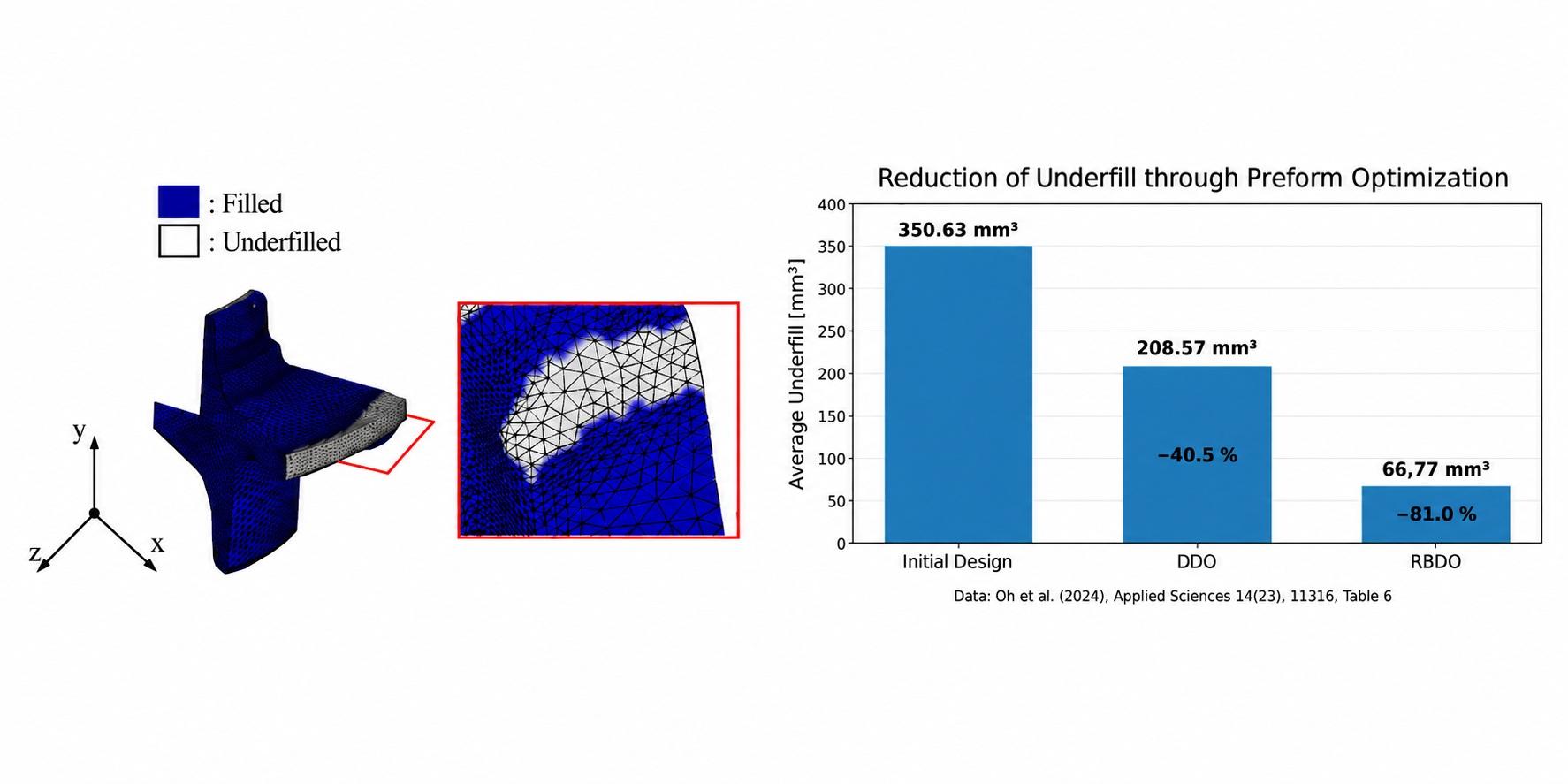
The results are significant: in the initial design, the mean underfill volume was 350.63 mm3. Deterministic optimization reduced this value to 208.57 mm3. With reliability-based optimization, it was reduced further to 66.77 mm3.
An even more informative indicator is process reliability. The calculated probability of violating the defined underfill criterion was 69.59 percent for the initial design. After deterministic optimization, it was reduced to 18.01 percent. For the robustly optimized RBDO design, it fell to only 0.81 percent.
This demonstrates the key economic benefit of simulation: a previously observed die-filling problem is translated into specific geometric design variables, these variables are optimized virtually, and their effects are evaluated quantitatively.
Process expertise instead of trial and error
For industrial forging companies, this approach means that preform development does not have to rely exclusively on experience followed by physical die tryout. Experience remains indispensable, but it can be complemented by a systematic analysis of material flow performed predominantly in 3D.
AFDEX makes it possible to compare different preforms and process variants before modifying the die. This allows the causes of underfill to be narrowed down more systematically and promising variants to be identified before they are implemented in steel. This does not automatically eliminate every physical trial, but it can significantly reduce the number of costly correction loops and make process development considerably more targeted.
The close connection between MORPHOTEC and the AFDEX development environment is an essential part of the service offering. MORPHOTEC combines its own long-standing experience in numerical simulation and industrial process development with the methodological and process expertise of the AFDEX developers. Demanding tasks are therefore not treated as isolated software applications but are addressed in greater technical depth through the involvement of AFDEX developers, researchers and other specialists from the AFDEX environment.
AFDEX as an engineering service or for in-house simulation
MORPHOTEC provides forming simulations with AFDEX as an engineering service and distributes the AFDEX software throughout the European Union, Switzerland, Liechtenstein and the United Kingdom. Companies can have specific issues such as underfill, insufficient die filling, critical material flow or preform design analyzed and optimized by MORPHOTEC.
Alternatively, AFDEX can be used for a company's own in-house simulation activities following appropriate training. MORPHOTEC supports customers in getting started with the software and applying it across a broad range of metal-forming processes - from cold and hot forming to extrusion, drawing and rolling, as well as selected sheet-metal-forming applications.
Customers therefore gain more than access to simulation software. They benefit from the combination of MORPHOTEC's industrial CAE experience, direct cooperation with MFRC, the developer of AFDEX, and the expertise of researchers and other partners from the AFDEX environment. MFRC itself identifies international cooperation and collaborative research as integral elements of its AFDEX development strategy.
Reference
Oh, M.; Kim, J.; Cho, J.; Kim, M.; Joun, M.; Hong, S. (2024):
Reliability-Based Design Optimization of Bearing Hub Preform for Minimizing Defects Considering Manufacturing Tolerance in Hot Forging Process.
Applied Sciences, 14(23), 11316. DOI: 10.3390/app142311316.