Reducing Material Use in Bulk Metal Forming - Billet and Process Optimization with AFDEX
Material costs have a direct impact on the economic efficiency of components produced by bulk metal forming. At the same time, the amount of starting material cannot simply be reduced without limit. If too little material is provided or if it is distributed unfavorably, areas of the die cavity may not be completely filled, required machining allowances may be insufficient, or the process may become unstable. The key question is therefore not simply how to use as little material as possible, but rather: How far can the billet be reduced without compromising reliable production of the component?
MORPHOTEC uses AFDEX to determine this limit before physical die tryout and to systematically coordinate die geometry, billet design, and process parameters. As an AFDEX partner with a sales territory covering the European Union, Switzerland, Liechtenstein, and the United Kingdom, MORPHOTEC works closely with MFRC, the developer of AFDEX. Through this close cooperation with MFRC, direct exchange with AFDEX developers and researchers, and the involvement of specialists and research partners from the AFDEX environment, MORPHOTEC has extensive methodological and process expertise that is directly applied in industrial customer projects.
Less Material Is Only Better if the Process Still Works
In industrial practice, the required amount of starting material is often specified with a certain material allowance. This allowance increases process robustness but also adds material cost. Simply reducing billet size based on experience, empirical rules, or trial and error is therefore not a state-of-the-art optimization approach. What matters is how changes in material volume and die geometry affect material flow throughout the entire forming process.
AFDEX makes it possible to investigate these relationships virtually. Different geometries and material volumes can be simulated and compared with respect to die filling, material flow, forming force, and other relevant process variables. A general safety allowance can therefore be transformed into a technical optimization problem with clearly defined constraints.
MORPHOTEC uses this approach for simulation-based optimization of material utilization and forming processes. A published project from the AFDEX development and research environment demonstrates the method using a high-strength ball nut for the gear actuator of a dual-clutch transmission. For this geometrically demanding component, a closed-die cold forming process was investigated and optimized with AFDEX. The original manufacturing route was based on casting, while the subsequent investigations aimed, among other objectives, at improving productivity, reducing manufacturing costs, and lowering material consumption.
Die Geometry Determines the Required Material Volume
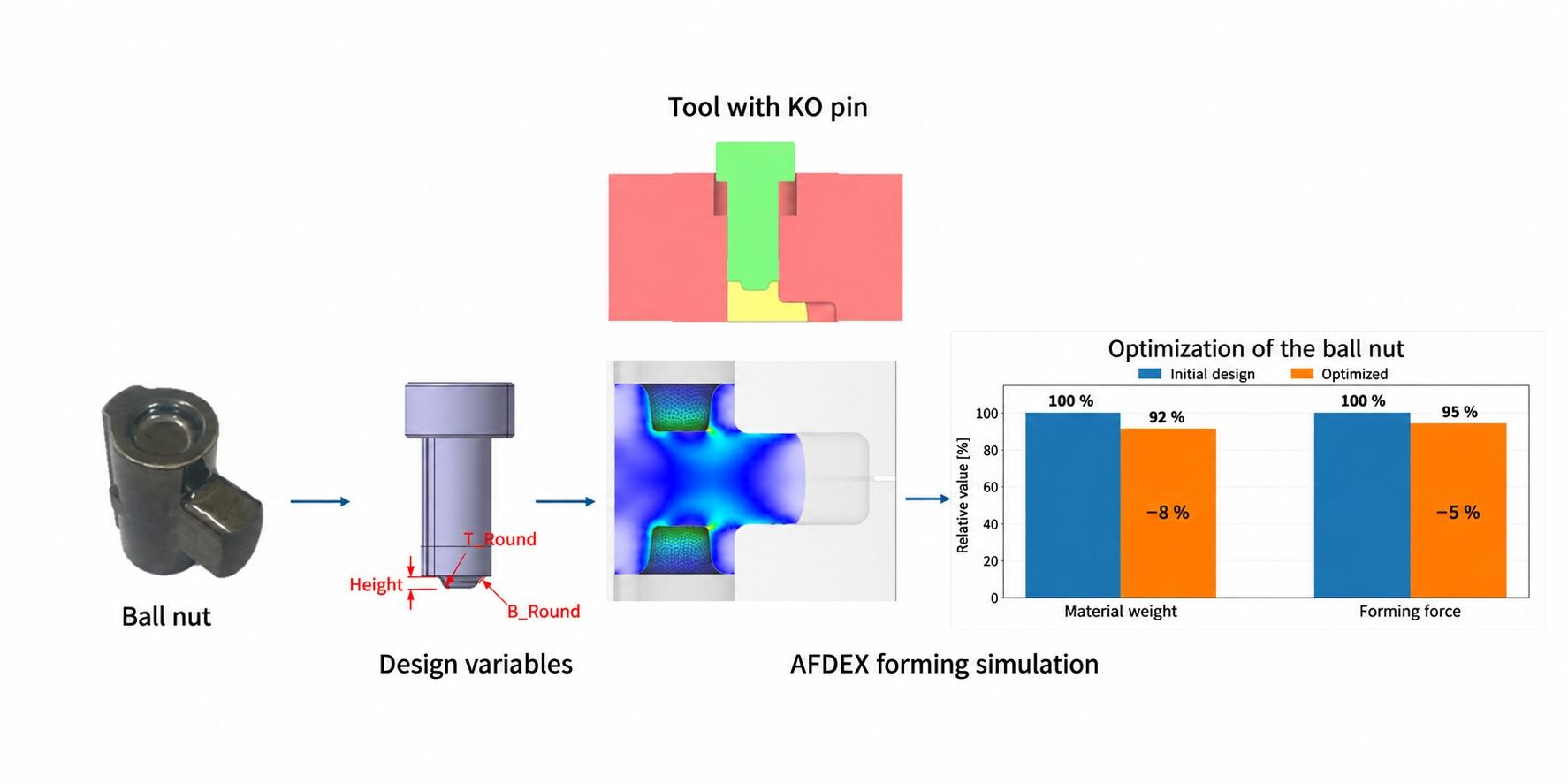
A particularly interesting aspect of this example is that the optimization did not simply involve changing the diameter or length of the billet. Instead, the researchers specifically investigated the geometry of the KO pin, or knock-out pin, which significantly influences material distribution in an important region of the component during closed-die cold forming.
Three geometric parameters were selected as design variables:
the height of the KO-pin projection: 4, 6, or 8 mm,
the upper radius of the projection: 1, 2, or 3 mm, and
the lower radius of the projection: 1, 2, or 3 mm.
The three parameters were investigated in nine selected design combinations using a Taguchi/DOE approach and AFDEX simulations. Instead of physically manufacturing and testing numerous die variants one after another, the influence of the individual geometric parameters could therefore be evaluated systematically.
Material Savings Under a Clearly Defined Technical Constraint
The optimization target was the volume of material required for manufacturing the component. At the same time, reducing the material volume could not be allowed to result in insufficient filling of regions required for subsequent machining.
For this purpose, the project evaluated the length of a material region reserved for subsequent machining. A minimum length of 23 mm had to be maintained. The simulation therefore had a clearly defined task: minimize the required material volume while simultaneously ensuring that the minimum geometry necessary for manufacturing remained available.
This constraint is crucial for industrial application. An optimization that merely produces a mathematical minimum for billet volume would be of little value if the component could no longer be manufactured and machined reliably, or if the required dimensional and geometric tolerances could no longer be achieved. AFDEX, by contrast, allows material usage and process requirements to be considered together.
Three Die Parameters - Nine Variants - One Targeted Solution
The AFDEX evaluations showed that all three investigated KO-pin parameters had a significant influence on the required material volume. The lowest required volume was predicted for the following parameter combination:
projection height: 8 mm
upper radius: 1 mm
lower radius: 3 mm
This demonstrates a key advantage of simulation-based process development: it does not merely identify a better result. It also makes it possible to understand which specific geometric change influences that result and in which direction the corresponding design parameter needs to be adjusted.
The methodology used in this reference project -- selecting technically adjustable design variables, generating targeted design variants, performing AFDEX simulations, and subsequently optimizing the process under defined constraints -- corresponds to the type of simulation-based process development that MORPHOTEC applies to industrial forming applications using AFDEX.
Eight Percent Less Material - and Lower Forming Force at the Same Time
The AFDEX Newsletter Q1/2020 provides a quantitative summary of the three-dimensional optimization of the closed-die cold forming process for the ball nut. Compared with the initial design, the material weight was reduced by 8 percent. At the same time, the required forming force decreased by 5 percent.
The result is significant in two respects. Reducing material weight directly lowers the amount of raw material required per component. At the same time, the optimized design in this case also reduced the required forming force by 5 percent. A lower forming force also reduces the mechanical load on the press and may decrease the energy required for the forming operation. At high production volumes, this can result in relevant energy savings during production.
The optimization therefore goes far beyond simply shortening a billet: die geometry, material flow, required material volume, and forming force are treated as an interconnected system.
Virtual Variants Instead of Die Corrections After Tryout
Especially in complex bulk metal forming processes, even small geometric changes can have a major influence on material flow. Determining which combination of die geometry and material volume provides the best compromise therefore cannot always be predicted reliably from experience alone.
Experience remains indispensable in process development. Simulation, however, allows this experience to be extended systematically: variants can be investigated virtually, unsuitable solutions can be eliminated, and promising geometries can be identified before dies are modified or new billet dimensions are tested in production.
This effect was explicitly highlighted in the ball-nut project. By combining systematic design variation with AFDEX simulation, the process optimization could be carried out in a structured manner while reducing the development effort required.
Material Efficiency Begins with Process Design
For manufacturing companies, reducing raw-material consumption results in a direct economic benefit that multiplies accordingly at high production volumes. The decisive factor is that this material reduction must be technically validated and must not come at the expense of die filling, machining allowances, or process robustness.
AFDEX can, for example, be used to investigate systematically:
how far billet volume can be reduced,
which die parameters determine material requirements,
whether all critical regions continue to be completely filled,
which machining allowances must be maintained,
how different variants affect material flow and forming force, and
which combination of billet and die geometry produces the most favorable process.
Material efficiency can therefore be integrated directly into process development instead of removing excess material after forming through trimming or machining.
The close relationship between MORPHOTEC and the AFDEX development environment is an important part of this service offering. MORPHOTEC combines its own long-standing experience in numerical simulation and industrial process development with the methodological and process expertise of the AFDEX developers. Challenging tasks are not treated merely as isolated software applications but are addressed in greater technical depth through the involvement of AFDEX developers, researchers, and other specialists from the AFDEX environment.
AFDEX as an Engineering Service or for In-House Simulation
MORPHOTEC provides forming simulation with AFDEX as an engineering service and distributes the AFDEX software throughout the European Union, Switzerland, Liechtenstein, and the United Kingdom. Companies can have MORPHOTEC investigate and optimize tasks such as reducing material consumption, optimizing billet and die geometries, solving material-flow problems, or determining forming forces.
Alternatively, following appropriate training, AFDEX can be used for in-house simulation. MORPHOTEC supports customers in getting started with the software and applying it across a broad range of metal forming processes -- from cold and hot forming to extrusion, drawing, and rolling, as well as selected sheet metal forming applications.
Customers therefore gain more than access to simulation software alone. They benefit from the combination of MORPHOTEC's industrial CAE experience, direct cooperation with AFDEX developer MFRC, and the expertise of researchers and other partners within the AFDEX environment.
References
Lee, Y. H.; Park, M. C.; Kim, M. C.; Joun, M. S.; Kim, B. M.; Kim, D. H. (2019):
Development of Cold Forming Process for Productivity Improvement of Actuator Ball Nut with Complex Shape and High Strength.
Korean Society for Technology of Plasticity, Fall Conference 2019, pp. 194-195.
MFRC (2020):
AFDEX Newsletter Q1/2020 - Successful Application Cases of AFDEX, Optimal Design for 3D Die Shape.